

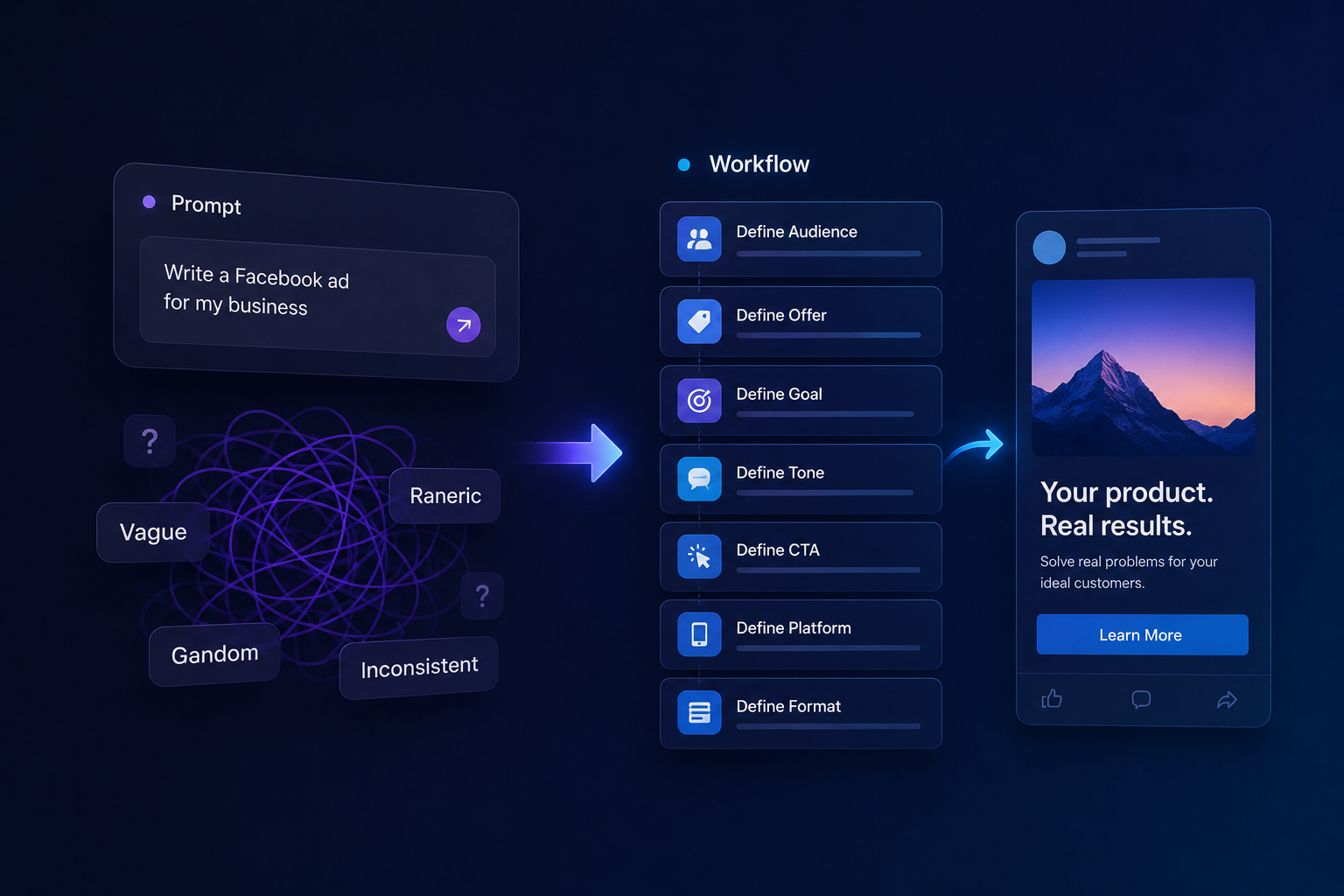
Using ChatGPT for work becomes far more effective when prompts are structured clearly and supported by repeatable AI workflows.
Most people think ChatGPT saves time.
Sometimes it does.
But most of the time?
It creates more editing.
More rewriting.
More fixing.
More “this sounds weird.”
The problem usually isn’t the AI.
It’s the way people use it.
What Most Prompt Lists Don’t Tell You
Most online prompt advice looks like this:
- “Use this prompt for LinkedIn”
- “Copy this for SEO”
- “Paste this into ChatGPT”
Sounds useful.
Until you try it.
Then everything comes out:
- generic
- robotic
- repetitive
- disconnected from your actual business
Because the AI has no real direction.
It’s just guessing.
Common “Best Prompts” (And Why They Fail)
Here’s a typical example:
“Write a high-converting ad for my product”
What’s missing?
- Who is the audience?
- What problem are we solving?
- What tone should it use?
- What platform is this for?
- What makes the product different?
The AI fills in the blanks itself.
And when AI guesses… quality drops fast.
The Pattern?
Most prompts fail because they are:
- too vague
- too short
- missing structure
- missing context
- missing clear goals
So the output becomes average.
Even if the AI itself is powerful.
What Actually Works Instead
The people getting strong AI results usually do one thing differently:
They stop treating AI like Google.
And start treating it like a junior employee.
A junior employee needs:
- instructions
- examples
- structure
- context
- clear outcomes
The same applies to AI.
Example: Marketing Content Workflow
Instead of saying:
“Write an Instagram caption”
A better workflow looks like:
- Define the audience
- Define the offer
- Define the goal
- Define the tone
- Define the CTA
- Define the platform
- Define the format
Now the AI has direction.
The output becomes sharper immediately.
Example: Ad Copy Workflow
Weak prompt:
“Write Facebook ads for my business”
Structured workflow:
- What product are you selling?
- What problem does it solve?
- Who is the customer?
- What objections do they have?
- What tone should the ad use?
- What action should people take?
That single difference changes everything.
Why Workflows Beat Prompts
A prompt is usually one instruction.
A workflow is a structured system.
That structure removes guessing.
And AI performs dramatically better when guessing is removed.
That’s why:
- structure improves quality
- context reduces guesswork
- systems outperform one-off prompts
The Real Shift
Most people don’t actually need “better prompts.”
They need:
- better thinking
- better structure
- better systems
The AI is already capable.
The missing piece is usually the workflow behind it.
So Are Prompts Useless?
No.
Prompts still matter.
But random copy-paste prompts rarely create consistent business results.
Structured workflows do.
That’s the difference between:
- experimenting with AI
vs - actually using AI effectively
Final Thought
AI is not magic.
It’s a tool.
And like any tool, the results depend on how you use it.
The people getting real results?
They use structured systems.
Ready to Stop Guessing With AI?
Most people waste hours testing random prompts that barely work.
Promptozia gives you structured AI workflows designed for real business tasks so you can:
- create faster
- think clearer
- automate repetitive work
- get more consistent outputs
👉 Browse AI Workflows