
AI can help you write faster.
But faster doesn’t always mean better.
Most AI-generated content sounds painfully obvious:
- generic LinkedIn posts
- robotic emails
- lifeless captions
- overused phrases
- fake motivational tone
And the worst part?
Most people can instantly tell it was written by AI.
The problem isn’t the AI itself.
The problem is how people use it.
Why Most AI Writing Sounds Generic
Most users treat AI like a vending machine.
They type:
“Write me a LinkedIn post about productivity.”
Or:
“Create an email for my customers.”
The AI has almost no context.
So it fills the gaps with:
- clichés
- safe wording
- repetitive structures
- overused buzzwords
- bland corporate language
That’s why so much AI content sounds identical.
The AI is guessing.
And when AI guesses… it defaults to average.
The Real Problem Isn’t AI
The real issue is vague prompting.
Most people don’t give the AI:
- a clear audience
- a specific tone
- a real objective
- examples
- structure
- context
So the output becomes generic by default.
Bad AI writing usually starts with bad instructions.
Example: Generic vs Better AI Usage
Generic Prompt
“Write a social media caption about teamwork.”
Typical output:
“Teamwork makes the dream work. Together we can achieve anything!”
Technically correct.
Completely forgettable.
Better Prompt
“Write a short LinkedIn post for startup founders about why small teams move faster than large corporations. Tone should feel direct, modern, slightly witty, and not corporate.”
Now the AI has:
- context
- audience
- tone
- direction
- purpose
The result instantly becomes more human and more useful.
The Biggest Mistakes People Make
1. Using One-Line Prompts
Short prompts create shallow outputs.
AI performs better with structure and detail.
2. Copy-Pasting Viral Prompts
Most “best prompts” online are too broad.
They create generic outputs because they’re designed for everyone.
Good AI usage is specific.
3. Ignoring Tone
Tone matters more than people think.
Without tone guidance, AI defaults to robotic professionalism.
4. Asking AI to Do Everything at Once
People often ask AI to:
- brainstorm
- write
- edit
- optimise
- format
…all inside one prompt.
This usually lowers quality.
Breaking tasks into steps produces better outputs.
What Actually Works Instead
The best AI users don’t rely on random prompts.
They use structured workflows.
Instead of asking:
“Write me content.”
They guide the AI through a process:
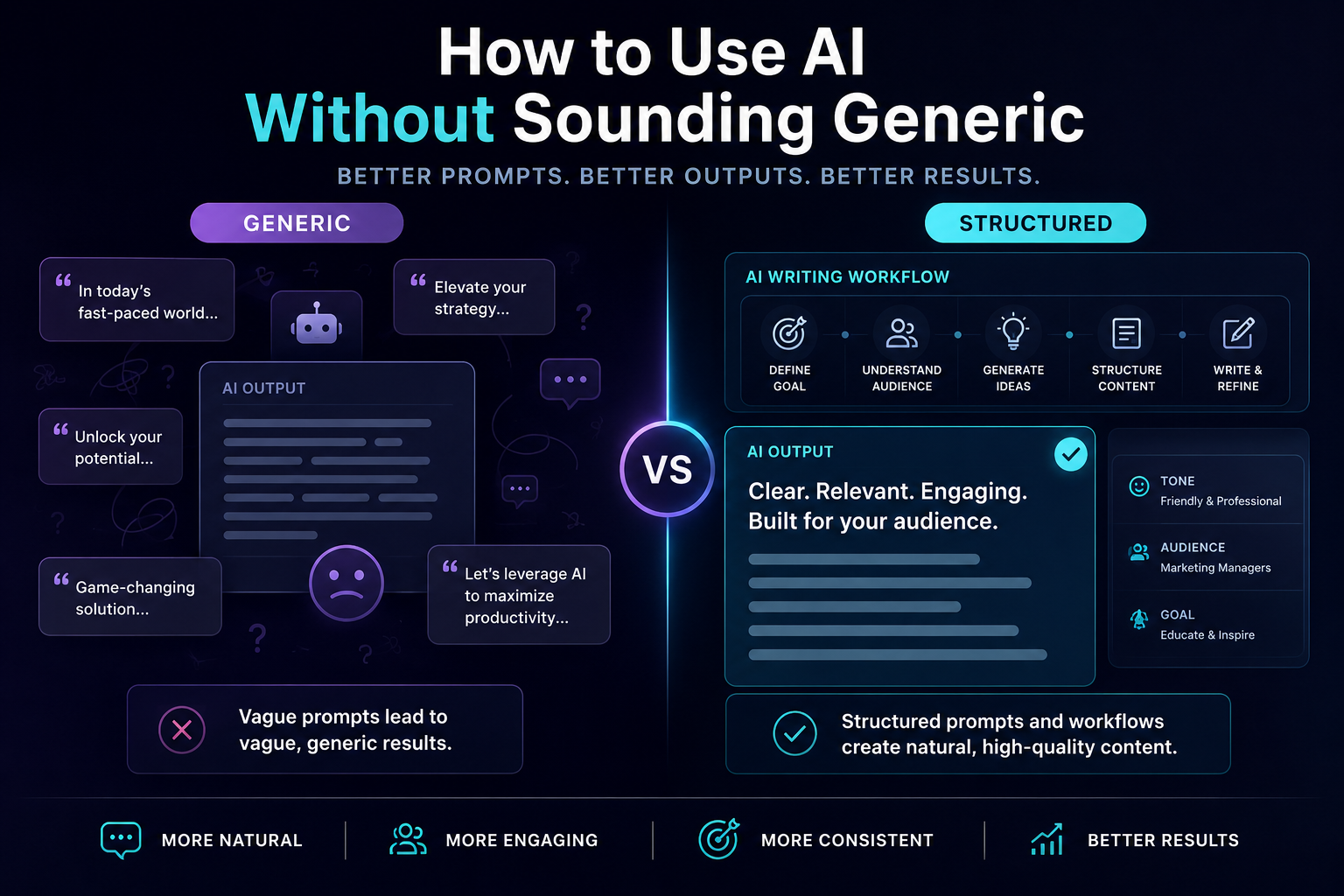
- define audience
- define goal
- generate angles
- refine messaging
- improve tone
- structure final output
That’s how you get outputs that feel:
- clearer
- more natural
- more consistent
- more professional
Real Example: Turning AI Into a Real Writing Assistant
Instead of:
“Write a blog post about AI.”
A workflow approach might look like this:
Step 1 — Define Audience
Who is this for?
Step 2 — Define Goal
Educate? Sell? Generate leads?
Step 3 — Generate Angles
Create multiple headline directions.
Step 4 — Build Structure
Outline sections before writing.
Step 5 — Write in a Specific Tone
Friendly? Witty? Technical? Direct?
Step 6 — Edit for Clarity
Remove fluff and robotic phrases.
This creates dramatically better results than one generic prompt.
Signs Your AI Content Sounds Too Generic
If your content includes phrases like:
- “In today’s fast-paced world”
- “Unlock your potential”
- “Game-changing solution”
- “Leverage AI”
- “Elevate your brand”
…it probably sounds AI-generated.
Modern readers recognise these patterns immediately.
Good AI-assisted writing should feel:
- clear
- specific
- useful
- natural
Not robotic.
Final Thought
AI is a tool.
Not a shortcut to good communication.
The people getting the best results from AI aren’t necessarily better writers.
They simply give better direction.
The quality of the output depends heavily on:
- context
- structure
- workflow
- specificity
That’s the real difference.
Ready to Get Better Results From AI?
Most people waste hours fixing weak AI outputs.
Structured workflows help you:
- create faster
- sound more natural
- improve consistency
- avoid robotic writing
- get better outputs with less trial and error
👉 Explore AI workflows designed for real-world marketing, business, and content creation tasks with Promptozia.ai