
Introduction
AI tools like ChatGPT can create:
- blog posts
- captions
- emails
- scripts
- ad copy
- product descriptions
…but most people still get weak results.
Why?
Because most prompts are too vague.
People type:
“Write me a blog post.”
And expect professional content.
The reality is:
better prompts create better outputs.
The good news?
Writing stronger AI prompts is not complicated once you understand structure.
Why Most AI Prompts Fail
Most prompts fail because they lack:
- context
- clarity
- direction
- constraints
- audience information
For example:
“Write me an Instagram caption.”
That tells AI almost nothing.
What industry?
What tone?
Who’s the audience?
What’s the goal?
Educational?
Funny?
Sales-focused?
Professional?
AI fills missing gaps with generic assumptions.
That’s why so much AI-generated content sounds repetitive.
The Biggest Misunderstanding About Prompting
Many people think prompting is about:
- secret phrases
- magic wording
- prompt hacks
It’s not.
Good prompting is mostly about communication.
The better your instructions, the better the result.
Professional AI users don’t rely on “magic prompts.”
They use structured workflows and context-rich instructions.
The Core Elements of a Strong AI Prompt
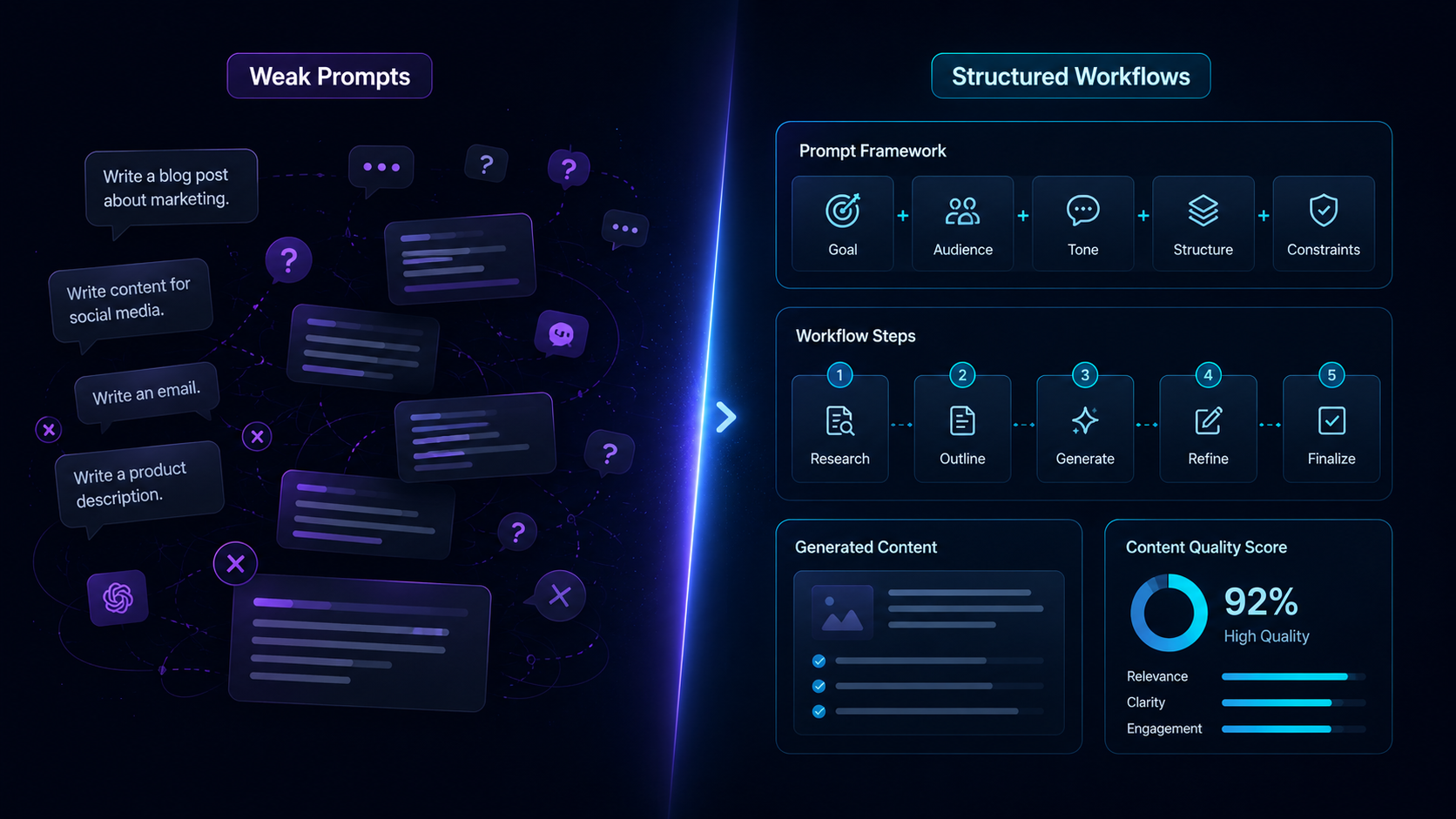
Good prompts usually contain five things:
1. Goal
Tell AI exactly what you want.
Example:
“Write a LinkedIn post explaining why workflows outperform random prompts.”
2. Audience
Define who the content is for.
Example:
“Target audience: small business owners with limited AI experience.”
3. Tone
Specify writing style.
Example:
“Tone: conversational, clear, slightly witty, professional.”
4. Structure
Tell AI how to organise the content.
Example:
- hook
- explanation
- examples
- CTA
5. Constraints
Tell AI what to avoid.
Example:
- no corporate jargon
- avoid emojis
- keep paragraphs short
- no robotic language
These details dramatically improve output quality.
Example: Weak Prompt vs Better Prompt
Weak Prompt
“Write a blog about AI marketing.”
Result:
- generic
- broad
- repetitive
- bland
Better Prompt
“Write a beginner-friendly blog post for small business owners explaining how structured AI workflows improve marketing results compared to random prompts. Use short paragraphs, conversational tone, practical examples, and avoid corporate buzzwords.”
Now the AI has:
- audience
- tone
- topic
- positioning
- structure
- constraints
The output instantly improves.
Why Structure Matters More Than Clever Wording
Many beginners obsess over tiny wording tweaks.
But structure matters far more.
The best AI users usually:
- break tasks into stages
- refine outputs gradually
- use reusable systems
- separate ideation from execution
Instead of:
“Write the final version immediately.”
They guide AI step-by-step.
That produces stronger content consistently.
How Workflows Improve Content Creation
Workflows help AI produce better outputs because they add process.
For example:
Instead of:
“Write me a YouTube script.”
A workflow might do this:
Step 1:
Generate video ideas.
Step 2:
Choose audience pain point.
Step 3:
Create hook options.
Step 4:
Build structure.
Step 5:
Draft script.
Step 6:
Improve pacing and tone.
Step 7:
Generate title and CTA.
This creates significantly better results than one generic prompt.
Common Prompting Mistakes
1. Being Too Vague
AI cannot read your mind.
Specificity matters.
2. Asking AI To Do Too Much
Huge all-in-one prompts usually lower quality.
Break tasks into stages instead.
3. Forgetting Tone Instructions
Without tone guidance, AI defaults to robotic professionalism.
4. No Audience Definition
Good content depends heavily on audience clarity.
5. Treating AI Like Magic
AI is a tool.
Not a replacement for strategy.
Real Content Tasks AI Handles Well
When prompted properly, AI becomes extremely useful for:
- blog outlines
- social captions
- email drafts
- ad variations
- YouTube hooks
- headline ideas
- product descriptions
- SEO structures
- content repurposing
The key is guidance.
Not randomness.
Final Thoughts
Most bad AI content comes from bad instructions.
Not bad tools.
The people getting the best results from AI are usually:
- more structured
- more specific
- more strategic
Better prompts are not about tricks.
They’re about clarity.
And once you combine prompting with workflows, the quality improves dramatically.
Ready to Get Better Results From AI?
Promptozia gives you structured AI workflows designed for:
- marketing
- content creation
- sales
- productivity
- operations
- automation
Instead of random prompts, you get repeatable systems designed for real execution.