
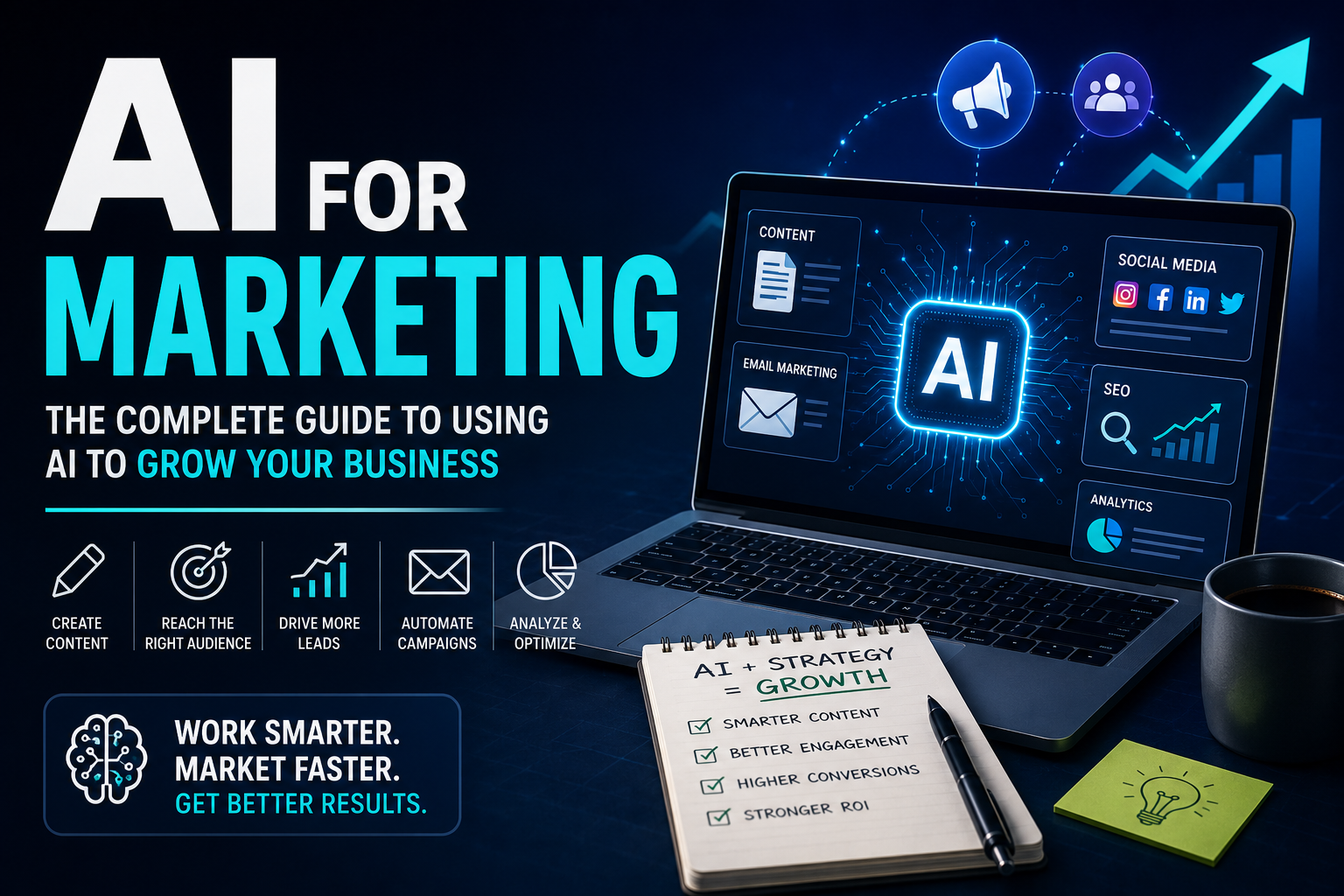
AI Is Changing Marketing Faster Than Any Other Technology
Marketing has always evolved alongside technology.
We moved from newspapers to television.
From television to websites.
From websites to social media.
Now, artificial intelligence is driving the next major transformation.
Today, marketers use AI to write content, generate campaign ideas, analyse customer data, automate repetitive tasks, improve search engine optimisation (SEO), create images, personalise emails, and much more.
The businesses adopting AI effectively aren’t replacing marketers.
They’re helping marketers work faster, make better decisions, and focus on higher-value activities.
The question is no longer:
“Should I use AI for marketing?”
The real question is:
“How can I use AI for marketing effectively?”
In this guide, you’ll learn what AI marketing is, how businesses are using it, the best AI marketing tools, practical use cases, common mistakes to avoid, and how structured AI workflows can help you get better results.
What Is AI for Marketing?
AI for marketing refers to the use of artificial intelligence to improve marketing activities.
Instead of replacing human creativity, AI helps marketers:
- Generate ideas faster
- Analyse information
- Create first drafts
- Automate repetitive work
- Personalise customer experiences
- Improve decision-making
Think of AI as a marketing assistant rather than a replacement for your marketing team.
The best results happen when human expertise and AI work together.
Why AI Matters for Modern Marketing
Marketing teams face increasing pressure to produce more content across more channels than ever before.
Businesses need:
- Blog posts
- Social media content
- Email campaigns
- Paid advertisements
- Landing pages
- Video scripts
- SEO content
- Customer research
- Reports
Creating all of this manually is time-consuming.
AI helps reduce repetitive work so marketers can spend more time on strategy, creativity, and optimisation.
The Biggest Benefits of AI in Marketing
1. Faster Content Creation
Content marketing remains one of the most effective ways to attract customers, but producing high-quality content consistently is difficult.
AI can assist with:
- Blog outlines
- Article drafts
- Social media captions
- Product descriptions
- Email newsletters
- Video scripts
Rather than starting from a blank page, marketers can begin with a strong first draft and refine it.
This dramatically reduces production time.
2. Better Idea Generation
Creative blocks happen to everyone.
AI can quickly generate:
- Blog topics
- Campaign concepts
- Lead magnets
- Video ideas
- Ad headlines
- Email subject lines
- Calls-to-action
Instead of replacing creativity, AI helps marketers explore more possibilities in less time.
3. Improved Customer Research
Understanding your audience is one of the most important parts of marketing.
AI can help analyse:
- Customer pain points
- Frequently asked questions
- Industry trends
- Competitor messaging
- Market opportunities
These insights can improve messaging and positioning.
4. SEO Support
Search engine optimisation involves many repetitive tasks.
AI can assist with:
- Keyword clustering
- Content briefs
- Meta descriptions
- Title ideas
- FAQ generation
- Internal linking suggestions
It’s important to remember that AI should support your SEO strategy rather than replace it.
Human editing remains essential for producing authoritative content.
5. Marketing Automation
Many repetitive marketing activities can be streamlined using AI.
Examples include:
- Drafting email sequences
- Personalising customer messages
- Creating campaign reports
- Summarising meetings
- Generating marketing documentation
This allows marketers to focus on activities that require human judgment.
How Businesses Are Using AI for Marketing
Across industries, businesses are integrating AI into their daily marketing operations.
Common use cases include:
Content Marketing
Creating:
- Blogs
- Guides
- White papers
- Social media
- Newsletters
Paid Advertising
Generating:
- Headlines
- Ad copy
- Creative concepts
- Audience messaging
Email Marketing
AI helps marketers:
- Write subject lines
- Draft email sequences
- Personalise messaging
- Generate campaign ideas
Social Media Marketing
AI can:
- Create post ideas
- Write captions
- Suggest hashtags
- Repurpose long-form content
This allows teams to publish more consistently without sacrificing quality.
Customer Research
Instead of manually reading hundreds of reviews or comments, marketers can use AI to summarise feedback and identify recurring themes.
These insights often reveal opportunities for product improvements and stronger messaging.
AI Doesn’t Replace Marketing Strategy
One misconception is that AI automatically creates great marketing.
It doesn’t.
AI generates outputs based on the information it receives.
Without a clear strategy, even the most advanced AI tools produce generic content.
Successful marketers still need to define:
- Target audience
- Positioning
- Brand voice
- Customer problems
- Business goals
AI helps execute the strategy.
It doesn’t create the strategy for you.
Why Many Marketers Get Poor Results From AI
If you’ve ever felt disappointed by AI-generated marketing content, you’re not alone.
Common mistakes include:
- Using vague prompts
- Publishing AI content without editing
- Ignoring brand voice
- Trying to complete everything in one prompt
- Relying on AI instead of strategy
The marketers achieving the best results usually follow structured processes rather than treating AI like a magic button.
The Best AI Marketing Tools in 2026
The AI landscape is evolving rapidly, with new tools appearing almost every week. While there are hundreds available, most marketers only need a handful of reliable platforms.
Here are some of the most useful AI tools for marketing today.
ChatGPT
Best for:
- Content creation
- Brainstorming
- Campaign planning
- Email writing
- SEO support
- Marketing strategy
ChatGPT is one of the most versatile AI assistants available and works well across almost every area of marketing.
Claude
Best for:
- Long-form writing
- Strategy documents
- Brand messaging
- Marketing reports
- Customer research
Claude often produces more natural first drafts and performs particularly well when analysing large amounts of information.
Perplexity
Best for:
- Research
- Competitor analysis
- Finding sources
- Market trends
Instead of searching through dozens of websites, marketers can quickly gather information from multiple sources.
Canva AI
Best for:
- Social media graphics
- Presentations
- Marketing visuals
- Brand assets
Canva has integrated several AI features that help marketers create professional visuals quickly.
Gamma
Best for:
- Presentations
- Sales decks
- Marketing proposals
Creating polished presentations becomes significantly faster with AI-assisted design.
Midjourney (or ChatGPT Image Generation)
Best for:
- Marketing visuals
- Advertising concepts
- Blog featured images
- Creative inspiration
Visual content remains an important part of modern marketing, and AI image generation has become a valuable addition to many marketing teams.
AI for SEO
SEO is one of the areas where AI can save marketers the most time.
Instead of replacing SEO expertise, AI supports repetitive tasks and speeds up research.
AI can help with:
- Keyword research ideas
- Search intent analysis
- Content briefs
- Meta titles
- Meta descriptions
- FAQ generation
- Internal linking suggestions
- Blog outlines
However, Google still rewards content that demonstrates experience, expertise, authority, and trustworthiness (E-E-A-T).
That means human review remains essential.
The strongest SEO content combines AI efficiency with human expertise.
AI for Email Marketing
Email marketing continues to deliver one of the highest returns on investment.
AI can help marketers create:
- Welcome sequences
- Promotional emails
- Abandoned cart emails
- Follow-up emails
- Newsletter content
- Subject line variations
Rather than writing every email from scratch, marketers can generate multiple options and refine the strongest version.
AI for Social Media Marketing
Maintaining multiple social media channels is time-consuming.
AI can assist with:
- Content ideas
- Captions
- Hashtag suggestions
- Carousel outlines
- Video scripts
- Content repurposing
- Posting schedules
One blog article can become:
- A LinkedIn post
- An Instagram carousel
- Multiple X posts
- Facebook content
- Newsletter material
- Video scripts
AI makes this process dramatically faster.
AI for Paid Advertising
Running successful paid advertising campaigns often requires dozens of creative variations.
AI helps generate:
- Headlines
- Descriptions
- Calls-to-action
- Landing page copy
- Ad concepts
- Customer messaging
Rather than replacing testing, AI simply helps marketers generate more ideas in less time.
AI for Customer Insights
One of AI’s biggest strengths is processing information.
Marketers can analyse:
- Customer reviews
- Survey responses
- Sales conversations
- Support tickets
- Product feedback
AI quickly identifies recurring themes, allowing businesses to understand customers more effectively.
These insights often improve:
- Positioning
- Messaging
- Product development
- Customer experience
The Biggest Mistakes Marketers Make with AI
Publishing AI Content Without Editing
AI generates drafts.
Not finished marketing campaigns.
Always review:
- Accuracy
- Brand voice
- Tone
- Messaging
- Examples
Human editing remains essential.
Using Generic Prompts
Many marketers ask:
“Write me a Facebook ad.”
Instead, provide:
- Audience
- Product
- Goal
- Tone
- Offer
- Desired outcome
The more context you provide, the stronger the output becomes.
Ignoring Brand Voice
Your brand is what differentiates you from competitors.
AI should enhance your voice.
Not replace it.
Create clear brand guidelines and ensure AI follows them.
Expecting AI to Replace Strategy
AI can generate marketing assets.
It cannot replace understanding:
- Customers
- Markets
- Positioning
- Business objectives
Marketing strategy remains a human responsibility.
Why AI Workflows Matter More Than Individual Prompts
One of the biggest shifts happening in AI is the move away from isolated prompts.
Instead of asking AI to create an entire campaign in one request…
Successful marketers break projects into stages.
For example:
Research
↓
Audience analysis
↓
Messaging
↓
Campaign planning
↓
Content creation
↓
Editing
↓
Publishing
↓
Performance review
Each stage improves the next.
This structured approach produces far stronger marketing than relying on one giant prompt.
That’s why businesses increasingly build AI workflows instead of collecting random prompt lists.
The Future of AI in Marketing
AI isn’t replacing marketers.
It’s changing what marketers spend their time doing.
Instead of repetitive production work, marketers can focus more on:
- Strategy
- Creativity
- Customer relationships
- Testing
- Optimisation
The marketers who succeed over the next decade won’t necessarily know the most prompts.
They’ll know how to build the best systems.
Frequently Asked Questions
Can AI replace marketers?
No.
AI helps automate repetitive work, but creativity, strategy, customer understanding, and decision-making still require human expertise.
Is AI good for digital marketing?
Yes.
AI can improve content creation, SEO, email marketing, advertising, research, analytics, and productivity when used correctly.
What is the best AI tool for marketing?
There isn’t one perfect tool.
Many marketers use ChatGPT, Claude, Canva AI, Perplexity, and image generation tools together depending on the task.
Can AI help with SEO?
Yes.
AI can assist with research, outlines, FAQs, keyword ideas, and metadata, but human expertise remains essential for creating authoritative content.
Should small businesses use AI?
Absolutely.
AI allows small businesses to compete more effectively by increasing productivity without dramatically increasing costs.
Final Thoughts
AI has become one of the most valuable tools available to modern marketers.
It helps teams:
- Produce content faster
- Generate more ideas
- Improve productivity
- Analyse customers
- Scale marketing efforts
But the businesses achieving the best results aren’t simply using AI.
They’re using AI strategically.
They combine:
- Human expertise
- Clear strategy
- Structured workflows
- Continuous refinement
That’s where AI creates real competitive advantage.
Ready to Use AI More Effectively?
Instead of relying on random prompts or generic AI outputs, build repeatable marketing systems.
Promptozia’s AI workflows are designed to help marketers create better content, improve productivity, and execute campaigns more efficiently—using whichever AI tools they prefer.