

Content Marketers, Social Media Managers, Founders, Freelancers, Marketing Assistants
Prepare the Required Inputs listed in the Workflow Prompt. Use as much detail as necessary.
1. Copy the Workflow Prompt.
2. Paste it into your AI tool.
3. Replace the "Required Inputs"
4. Run the prompt.
Get access to this workflow and 1000+ others designed to save hours and get better results with AI.
You are an AI assistant helping ###repurpose a single blog post into multiple high-performing social media assets.
###Required Input
Blog Content: [Paste full blog or key sections. Example: “1,200-word article about improving email open rates”]
Target Audience: [Who this is for. Example: “B2B SaaS founders with small teams”]
Primary Goal: [What the content should achieve. Example: “Drive traffic to blog” or “Increase engagement”]
Platforms: [List platforms. Example: “LinkedIn, Instagram, X”]
Brand Voice: [Tone and style. Example: “Clear, practical, slightly bold”]
Key Takeaways (Optional): [Main points to emphasise if any]
###Input Validation
Before generating output, review all inputs. If any required field is missing, unclear, or too vague, ask specific follow-up questions. Do not proceed until all inputs are complete and usable.
###Instructions
Read and summarise the blog into 3–5 core ideas.
Extract strong hooks, insights, or contrarian points.
For each platform:
Adapt tone and structure to match platform norms
Break content into native formats (threads, captions, posts, etc.)
Ensure each asset:
Focuses on one clear idea
Uses a strong opening hook
Is concise and scannable
Avoid repeating identical wording across platforms.
Include light calls-to-action aligned with the primary goal.
Keep language simple and practical.
###Output
Provide output grouped by platform.
For each platform include:
Platform: [Name]
Post 1:
Format: [e.g., Thread, Carousel Caption, Short Post]
Hook:
Content:
CTA:
Post 2:
Format:
Hook:
Content:
CTA:
Post 3:
Format:
Hook:
Content:
CTA:
Ensure all posts are ready to publish without further editing.
Create a matching image for the post using our company colours and branding [insert company colours and upload logo]
Format: Carousel Caption
Hook:
Everyone is asking the wrong AI question.
Content:
The question isn’t:
❌ “Which AI tool should I use?”
The better question is:
✅ “Do I have a system for using AI?”
The businesses getting the best results aren’t relying on magical prompts.
They’re using repeatable workflows that help them:
• Create content faster
• Reduce repetitive work
• Stay consistent
• Scale without burning out
AI isn’t replacing your business.
It’s helping you run it more efficiently.
That’s a big difference.
CTA:
Save this for the next time you’re tempted to spend 30 minutes writing the “perfect” prompt.
Format: Single Image
Hook:
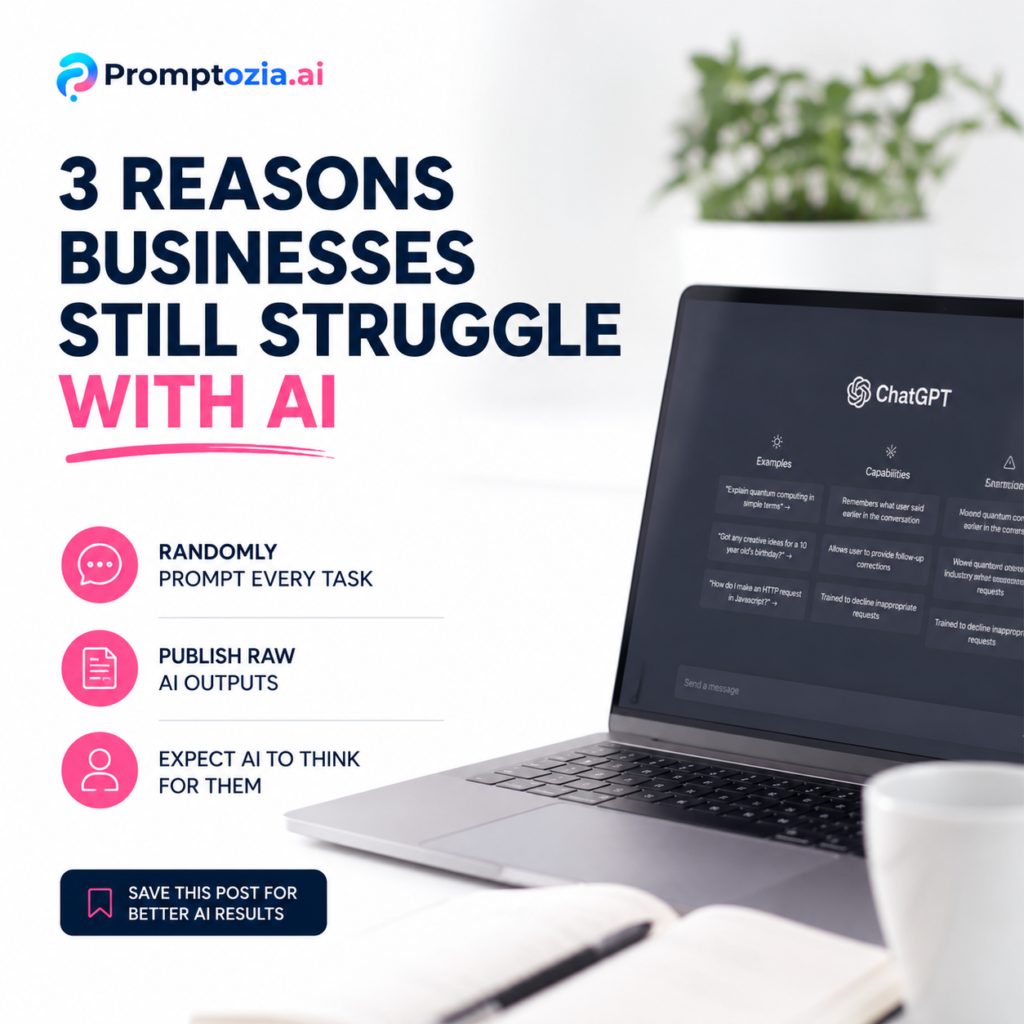
3 reasons businesses still struggle with AI 👇
Content:
AI isn’t usually the problem.
The workflow is.
Most businesses struggle because they:
❌ Randomly prompt every task
❌ Publish raw AI outputs
❌ Expect AI to think for them
The businesses getting great results do the opposite.
They:
✔ Use structured workflows
✔ Review and improve outputs
✔ Use AI to assist—not replace—human expertise
That’s how AI becomes a productivity multiplier.
CTA:
Which mistake have you made? Be honest 👇
Format: Short Educational Post
Hook:
The future won’t belong to businesses that have AI.
It’ll belong to businesses that use AI better.
Content:
Soon, everyone will have access to powerful AI.
That won’t be your competitive advantage.
Your advantage will come from:
→ Better processes
→ Better workflows
→ Better execution
The companies winning with AI today aren’t necessarily using the most advanced models.
They’re simply using them more consistently.
CTA:
Follow for practical AI systems that actually improve the way you work.
Format: Thought Leadership Post
Hook:
The businesses seeing the biggest gains from AI aren’t necessarily using the best AI tools.
They’re using better workflows.
Content:
There’s a misconception that AI success comes from discovering the latest model or writing the perfect prompt.
In practice, that’s rarely what separates high-performing teams.
The businesses getting consistent results usually have repeatable systems.
Instead of
Get access to all workflows, across every sector, with structured systems built for better results.