
🟢 Introduction
A good AI prompt gives clear instructions, useful context, and structured guidance that helps AI generate better results.
Most people think using AI is simple.
You open a tool like ChatGPT, type a quick sentence, and expect a great result.
But what usually happens?
You get something… okay.
Generic. Vague. Not quite usable.
So you try again. And again.
Wasting time instead of saving it.
The truth is:
👉 The quality of your results depends almost entirely on how you ask.
This is where prompting comes in.
🧠 What Is an AI Prompt?
An AI prompt is simply the instruction you give to an AI tool.
But here’s the important part:
👉 AI doesn’t “think” like a human.
It responds based on patterns, structure, and clarity.
So when your prompt is unclear, the output will be unclear.
⚠️ Why Most Prompts Fail
Most people write prompts like this:
“Write a social media post about fitness”
What’s missing?
- Who is it for?
- What tone?
- What goal?
- What format?
The AI has to guess everything.
And when AI guesses… you get average results.
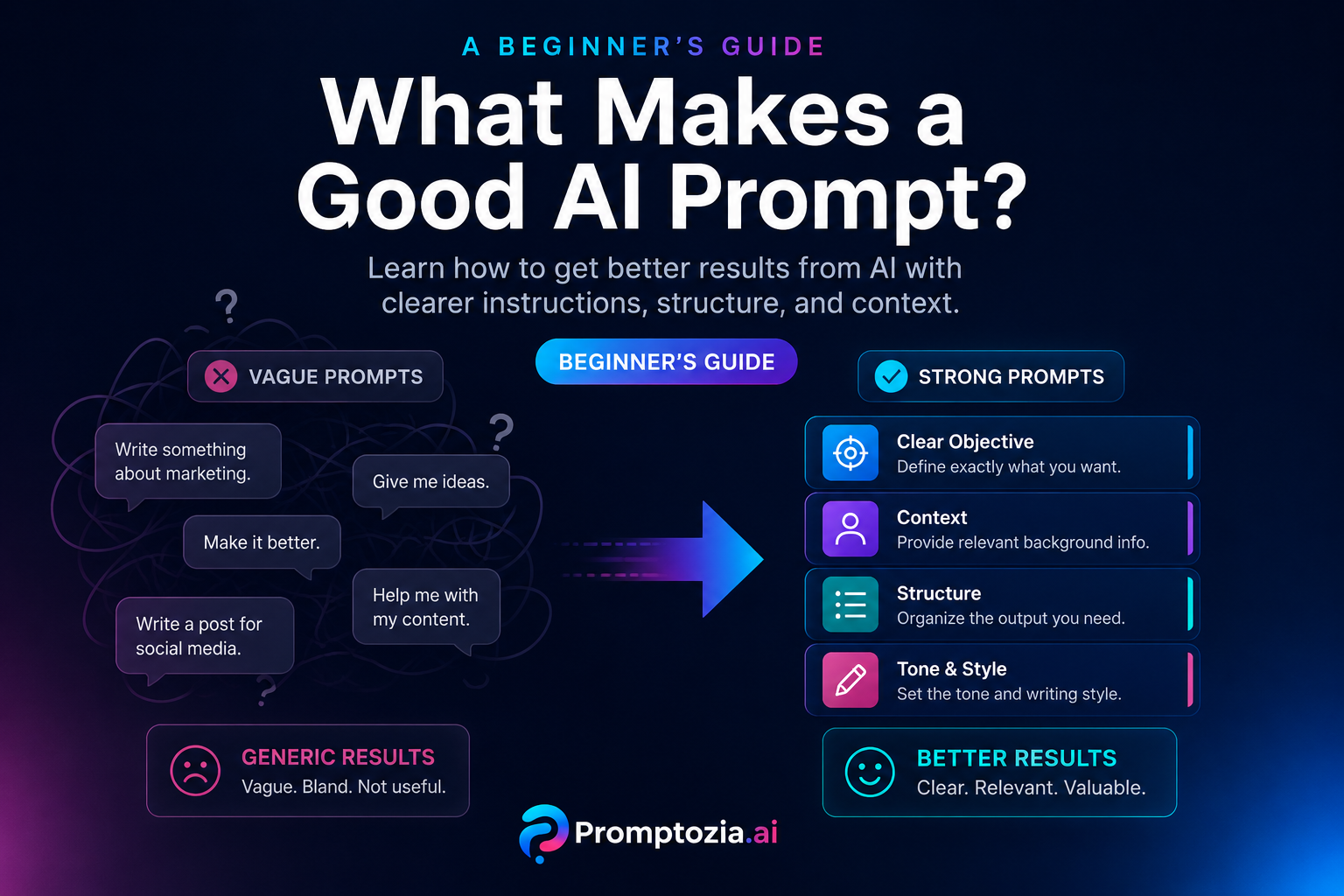
🔑 What Makes a Good AI Prompt?
A good prompt removes guessing.
It gives the AI direction, context, and structure.
Here are the 4 key elements:
1. 🎯 Clear Objective
Tell the AI exactly what you want.
Bad:
“Write something about marketing”
Better:
“Write an Instagram caption promoting a new fitness program”
2. 👥 Context
Give background so the AI understands the situation.
Example:
“The target audience is busy professionals aged 25–40 who want quick workouts”
3. 🧾 Structure
Tell the AI how to format the output.
Example:
- Bullet points
- Short paragraphs
- Hook + body + CTA
4. 🎨 Tone & Style
This changes everything.
Example:
- Professional
- Casual
- Funny
- Persuasive
🧩 Example: Weak vs Strong Prompt
❌ Weak Prompt:
“Write an email about a product”
✅ Strong Prompt:
“Write a persuasive email promoting a new time-saving productivity app for busy professionals. Keep the tone friendly and slightly informal. Structure it with a strong opening hook, 3 key benefits, and a clear call-to-action.”
👉 Same task. Completely different result.
🧠 The Real Problem
Even if you understand this…
Most people still struggle.
Because writing good prompts consistently is hard.
You have to think about:
- structure
- tone
- context
- formatting
- clarity
Every single time.
🔁 This Is Where Most People Get Stuck
You don’t just need a “good prompt”.
👉 You need a repeatable system.
Something that:
- removes guesswork
- ensures consistent quality
- works across different tasks
⚡ The Next Level: Prompt vs Workflow
A prompt is a single instruction.
A workflow is a step-by-step system that guides the AI through a process.
Instead of:
“Write a blog post”
A workflow might:
- Define the topic
- Generate an outline
- Expand each section
- Refine tone
- Optimize structure
👉 This is how you get professional-level outputs
🚫 Common Mistakes to Avoid
- Being too vague
- Not specifying audience
- Ignoring tone
- Asking for too much in one prompt
- Not refining outputs
✅ Key Takeaways
- Better prompts = better results
- Clarity beats creativity
- Structure improves quality
- Context reduces guesswork
- Systems outperform one-off prompts
🔻 Final Thought
AI is not magic.
It’s a tool.
And like any tool, the results depend on how you use it.
Most people stay stuck because they rely on random prompts.
The people getting real results?
👉 They use structured systems.
Ready to Get Better Results from AI?
Most people waste hours experimenting with prompts that barely work.
Promptoza gives you structured AI workflows designed to help you:
- create faster
- think clearer
- automate repetitive tasks
- and get more consistent outputs
👉 Browse AI Workflows