
Introduction
Most people using AI today rely on prompts.
They type:
- questions
- requests
- instructions
- commands
…and wait for AI to generate something useful.
Sometimes it works.
Sometimes it doesn’t.
The problem?
Most people stop at prompting.
But the people getting the best AI results usually go much further.
They use workflows.
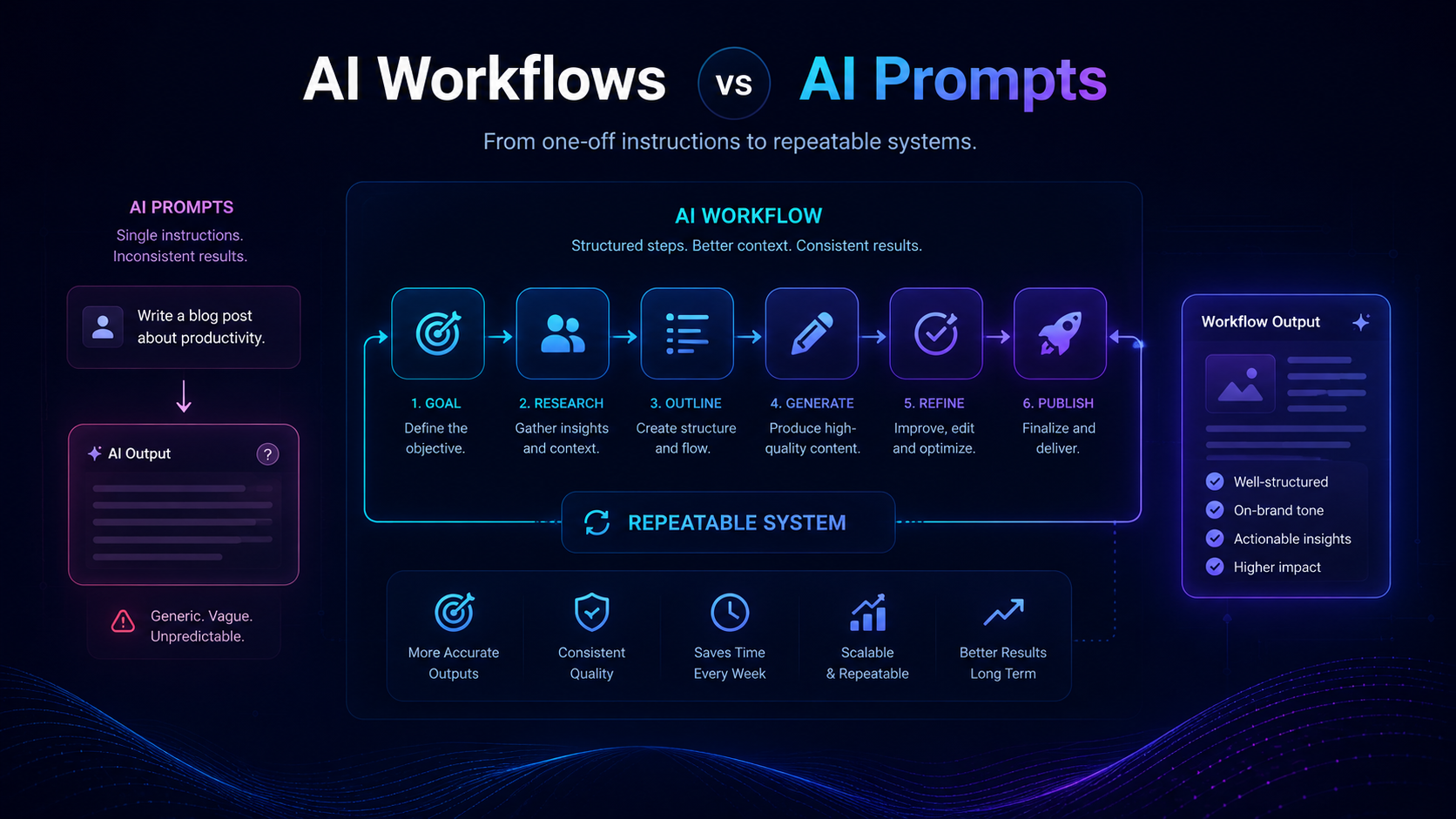
Understanding the difference between AI prompts and AI workflows is one of the biggest shifts in using AI effectively.
What Is an AI Prompt?
An AI prompt is a single instruction given to an AI tool.
Example:
“Write a LinkedIn post about productivity.”
Or:
“Create an email for my customers.”
Prompts are inputs.
They tell AI what task to perform.
Simple prompts can absolutely be useful.
But prompts alone often produce:
- inconsistent results
- generic outputs
- repetitive content
- weak structure
Especially for complex business tasks.
What Is an AI Workflow?
An AI workflow is a structured multi-step process.
Instead of relying on one instruction, workflows guide AI through stages.
For example:
Instead of:
“Write a blog post.”
A workflow might include:
- audience research
- topic generation
- outline creation
- hook generation
- drafting
- editing
- tone refinement
- CTA creation
This creates dramatically better outputs.
Because the AI receives:
- more context
- clearer direction
- better structure
- less ambiguity
Why Prompts Often Fail
Most prompts fail because they are:
- too broad
- too vague
- missing context
- overloaded
- poorly structured
Example:
“Write a high-converting ad.”
That tells AI very little.
Who is the audience?
What is the product?
What tone should it use?
What problem is being solved?
AI fills the gaps with assumptions.
That’s why outputs often sound generic.
Why Workflows Produce Better Results
Workflows reduce guesswork.
They create:
- structure
- sequence
- repeatability
- consistency
Instead of generating everything at once, workflows guide AI step-by-step.
This improves:
- quality
- clarity
- relevance
- tone
- usability
Especially for:
- marketing
- content creation
- operations
- productivity
- sales
The Biggest Misunderstanding About AI
Many people think:
“Better prompts = better AI.”
That’s only partially true.
In reality:
- better prompts help
- structured workflows help much more
The real productivity gains come from systems.
Not isolated one-off prompts.
Prompt Libraries vs Workflow Systems
This is an important distinction.
Many AI tools offer:
- huge prompt collections
- prompt marketplaces
- prompt databases
But prompts without process usually create inconsistent results.
A workflow system is different.
It connects prompts into a repeatable operational structure.
That’s what businesses actually need.
Example: Social Media Content
Prompt Approach
“Write 10 Instagram captions.”
Result:
- inconsistent tone
- weak strategy
- repetitive hooks
- generic CTAs
Workflow Approach
Step 1:
Identify audience pain point.
Step 2:
Choose content angle.
Step 3:
Generate hooks.
Step 4:
Draft captions.
Step 5:
Refine tone.
Step 6:
Create CTA variations.
Now the outputs feel:
- more strategic
- more targeted
- more usable
Workflows Make AI More Scalable
This is where workflows become powerful.
Once a workflow works consistently, it can be reused repeatedly.
That creates:
- operational efficiency
- content consistency
- faster execution
- reduced decision fatigue
This is why businesses increasingly rely on workflow-based AI systems.
Not random prompting.
AI Workflows Are Not Automation
This is another common misconception.
AI workflows guide thinking and generation.
Automation executes repetitive tasks automatically.
Sometimes they overlap.
But they are not the same thing.
A workflow can still involve:
- human review
- editing
- approvals
- creative judgment
The Real Goal
The goal is not:
“Generate more AI outputs.”
The goal is:
- better outputs
- more consistent outputs
- reusable systems
- operational efficiency
That requires workflows.
Not random experimentation.
Final Thoughts
Prompts are useful.
But workflows are where AI becomes genuinely powerful.
The people getting the best results from AI usually:
- use systems
- structure tasks
- refine processes
- think operationally
That’s the real difference between casually using AI and actually leveraging it productively.
Want ready-to-use AI workflows instead of random prompts?
Explore structured systems and practical AI workflows designed for real business tasks at Promptozia.ai.