
Introduction
Most people use AI through prompts.
They type a request into ChatGPT, Claude, Gemini, or another AI tool and hope for a good result.
Sometimes it works.
Sometimes it doesn’t.
That inconsistency is exactly why more advanced AI users rely on workflows instead of random prompting.
Understanding the difference between AI prompts vs AI workflows is one of the biggest shifts that improves AI results long term.
Because better AI outputs rarely come from one perfect prompt.
They usually come from structured systems.
What Is an AI Prompt?
An AI prompt is a single instruction given to an AI tool.
Examples:
- “Write a LinkedIn post.”
- “Create a sales email.”
- “Generate blog ideas.”
- “Summarise this document.”
Prompts are useful.
But prompts alone are often incomplete.
The AI still has to guess:
- audience
- tone
- objective
- structure
- context
- positioning
- formatting
That’s why random prompting often produces inconsistent results.
What Is an AI Workflow?
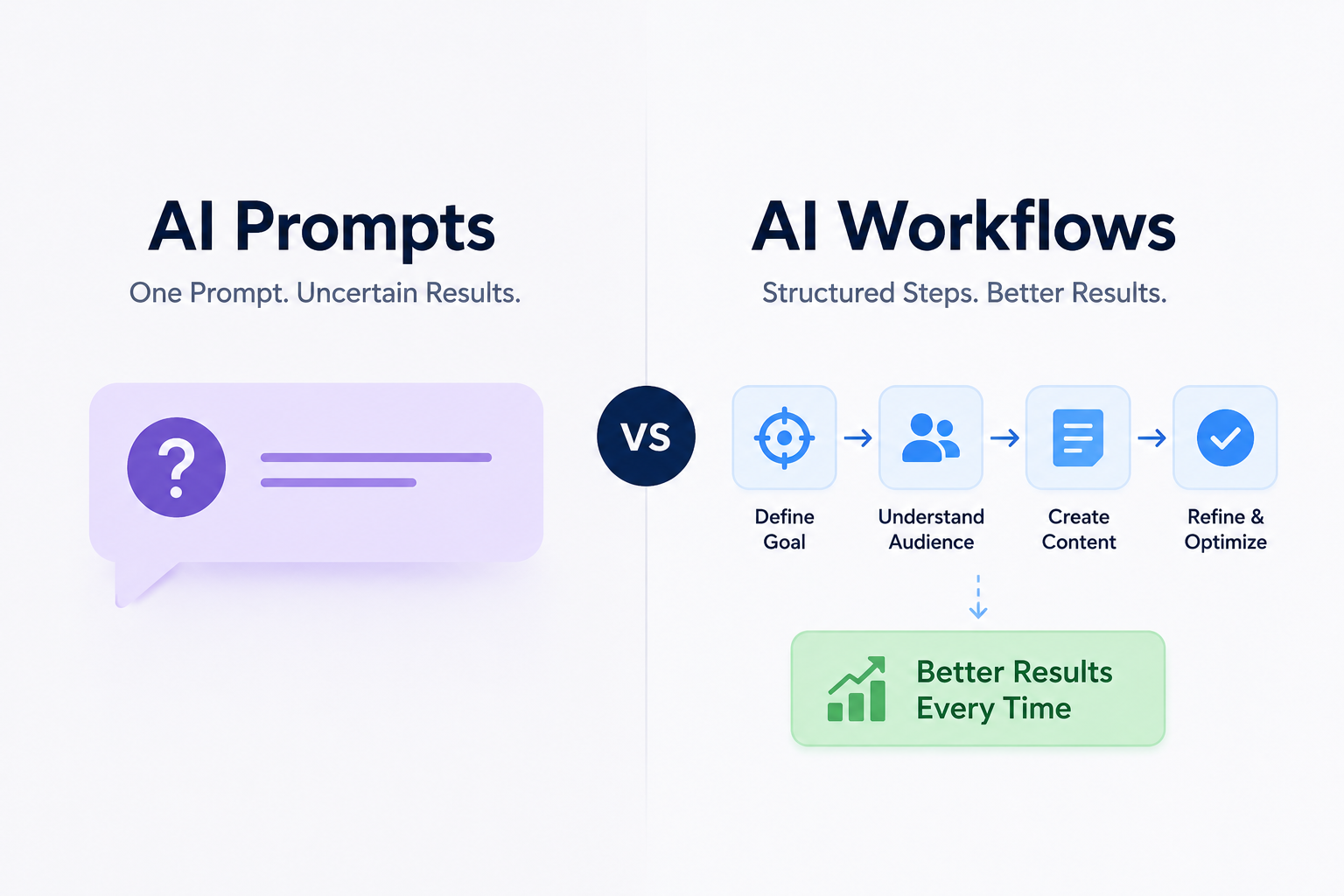
An AI workflow is a structured sequence of steps designed to guide AI toward a better outcome.
Instead of relying on one instruction, workflows break tasks into stages.
For example:
Simple Prompt Approach
“Write a blog post about productivity.”
Workflow Approach
- Define audience
- Define objective
- Research pain points
- Create headline options
- Build outline
- Generate draft
- Refine tone
- Optimise formatting
- Finalise CTA
The second process creates far more control and consistency.
Why Prompts Often Fail
Most prompts fail because they are too vague.
AI tools are trained on enormous amounts of internet content.
When instructions lack clarity, AI defaults toward average outputs.
That usually creates content that feels:
- generic
- repetitive
- robotic
- overexplained
- forgettable
This is why many people become frustrated with AI after the initial excitement.
The problem is usually not the tool.
It’s the process.
Why Workflows Produce Better Results
Structured workflows reduce guesswork.
Instead of expecting AI to magically understand everything instantly, workflows guide the system step-by-step.
That improves:
- clarity
- consistency
- quality
- tone
- formatting
- strategic alignment
Most importantly:
Workflows create repeatable results.
That matters for businesses, teams, marketers, and creators who use AI regularly.
The Biggest Misconception About AI
Many users believe success comes from finding “the perfect prompt.”
But experienced AI users rarely depend on one-shot prompting.
They build systems.
Because AI performs better with:
- layered context
- structured inputs
- sequential tasks
- iterative refinement
The workflow itself becomes the advantage.
Not the prompt alone.
Real-World Example
Imagine two people trying to create social media content.
User A
Uses prompts like:
“Write 10 Instagram captions.”
Results:
- inconsistent tone
- weak hooks
- generic wording
- repetitive ideas
User B
Uses a workflow:
- Define audience
- Analyse pain points
- Create positioning angle
- Generate hook ideas
- Build content structure
- Generate captions
- Refine tone
- Optimise CTA
Results:
- clearer messaging
- stronger positioning
- more consistent branding
- better engagement potential
The workflow creates leverage.
Why Businesses Are Moving Toward AI Systems
Businesses need reliability.
Random prompting does not scale well across teams.
Structured AI workflows create:
- repeatable processes
- operational consistency
- faster execution
- easier delegation
- better collaboration
- scalable systems
That’s why workflows are becoming more important than standalone prompts.
Prompts Still Matter
This does not mean prompts are useless.
Prompts are still important.
But prompts work best inside systems.
A strong workflow often contains many smaller prompts working together.
The structure is what improves output quality.
The Future of AI Usage
The future of AI is not random prompting.
It’s operational workflows.
The people getting the best long-term results from AI are building:
- reusable systems
- structured processes
- repeatable frameworks
- scalable workflows
That’s the real competitive advantage.
Final Thoughts
Prompts help AI generate outputs.
Workflows help AI generate better results consistently.
That is the key difference.
The strongest AI users are not simply better at prompting.
They are better at building systems.
And those systems become repeatable advantages over time.
Stop Relying on Random Prompts
Structured AI workflows create clearer, faster, and more consistent results than standalone prompts alone.
Explore practical AI workflows and systems at Promptozia.ai.